
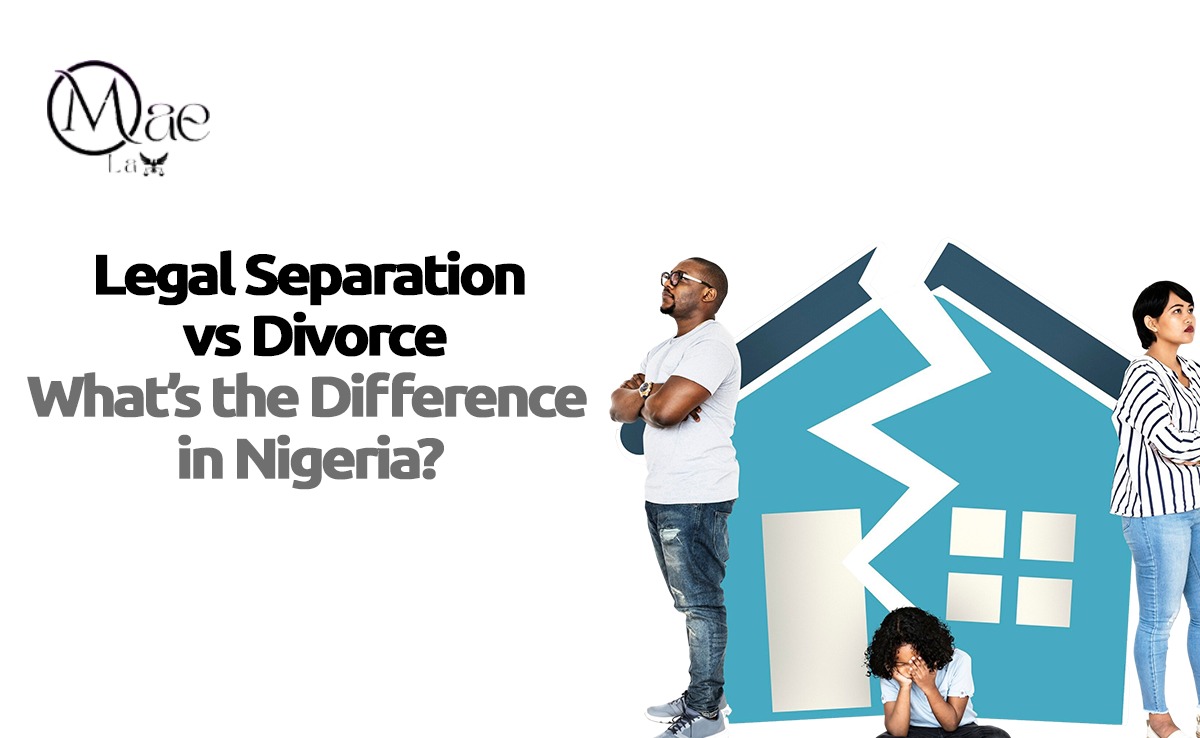
When a marriage faces serious challenges, couples often find themselves at a crossroads: do they stay and work things out, take a break, or end the marriage legally?
In Nigeria, the terms “legal separation” and “divorce” often come up in these conversations, yet many people are unclear about what they really mean and how they differ.
While both involve some level of legal recognition that a marriage is no longer functioning as it should, they are not the same thing. Understanding the difference between the two can help couples make informed decisions that fit their situation, whether that means taking time apart or ending the marriage completely.
Let’s break it down in simple terms.
Understanding Divorce in Nigeria
Divorce is the legal termination of a marriage; it marks the official end of the marital relationship.
Once a divorce is finalized, both parties are no longer legally married to each other and are free to remarry if they wish.
In Nigeria, marriage and divorce are regulated differently depending on the type of marriage entered into. The two most common forms are:
- Statutory Marriage (conducted under the Marriage Act)
- Customary or Islamic Marriage
Divorce under Statutory Marriage
If your marriage was conducted under the Marriage Act, then it’s governed by the Matrimonial Causes Act (MCA).
Under this law, a divorce can only be granted by a High Court, and the process is formal and sometimes lengthy.
To get a divorce, you must show that the marriage has broken down irretrievably.
This means the relationship has reached a point where it cannot be repaired.
The law outlines several grounds for proving this, including:
- Adultery by your spouse
- Unreasonable behaviour (such as cruelty, neglect, or abuse)
- Desertion for at least one year
- Living apart for two years (with consent) or three years (without consent)
- Failure to comply with court orders for restitution of conjugal rights
Once the court is satisfied that one or more of these grounds exist, it may grant a Decree Nisi, which becomes a Decree Absolute after a few months, officially ending the marriage.
Understanding Legal Separation in Nigeria
A legal separation, on the other hand, does not end the marriage.
It simply means that the couple has decided, either informally or through the court, to live apart and no longer function as a married couple, but without going through a divorce.
Think of legal separation as taking a structured break; you and your spouse stop living together, but the marriage is still legally valid.
Types of Legal Separation
In Nigeria, legal separation can take two main forms:
1. Judicial Separation
Under the Matrimonial Causes Act, a spouse may apply to the court for a Decree of Judicial Separation.
This means the court officially recognizes that the couple will live separately, but the marriage remains legally intact.
You can seek judicial separation for reasons similar to those required for divorce, such as cruelty, adultery, or desertion.
However, the key difference is that the court’s decision does not dissolve the marriage; it only suspends the duty to cohabit.
2. Mutual or Informal Separation
Some couples decide to separate informally, without going to court. They might simply agree to live apart for a while, either to cool off, seek counselling, or reassess their relationship.
While this type of separation isn’t recognized legally (meaning it doesn’t affect property rights or responsibilities in the eyes of the law), it’s still common among couples who prefer privacy or wish to avoid the cost and stress of court proceedings.
Understanding the Differences
The main difference between separation and divorce lies in their legal effect on the marriage.
In a legal separation, the marriage still exists, the couple remains legally married, but they are no longer required to live together. Either partner can decide to reconcile at any time and resume cohabitation without any new legal process.
In contrast, a divorce officially ends the marriage. Once finalized, the spouses are free to remarry and live independent lives.
A judicial separation is therefore not a final step; it can serve as a temporary arrangement that might lead to either reconciliation or, eventually, divorce. Divorce, on the other hand, is a final legal order that permanently dissolves the marriage.
Even during separation, certain marital rights and obligations continue to exist. For example, if one spouse passes away without leaving a will, the surviving partner may still be entitled to inheritance rights, as they are still legally married. Divorce, however, terminates all such legal ties and responsibilities.
A divorce petition is filed when one or both partners believe that the marriage has completely broken down and cannot be saved. Separation, while it may be based on similar issues (like neglect, cruelty, or desertion), is not filed on the basis that the marriage is beyond repair.
Under Nigerian law, there is only one legal ground for divorce, that the marriage has broken down irretrievably. Eight specific facts can be used to prove this breakdown in court. Interestingly, these same facts (like adultery, cruelty, or desertion) can also serve as reasons for seeking a judicial separation, but the intention is different: separation is not meant to end the marriage, only to provide space while the couple decides what comes next.
The Role of Mediation and Counselling
Before making any legal moves, it’s often helpful to explore mediation or counselling.
In Nigeria, some courts and family service organizations now encourage alternative dispute resolution (ADR) to help couples settle issues amicably.
Mediation can help both parties:
- Communicate openly about their expectations
- Find mutually acceptable solutions
- Reduce emotional and financial stress
- Protect children from prolonged conflict
Even when divorce becomes necessary, mediation can make the process smoother, faster, and less adversarial.
Conclusion
At the end of the day, the decision between legal separation and divorce comes down to your personal circumstances, beliefs, and long-term goals.
If you’re uncertain about your next step, consider speaking with a family law expert who can guide you through your options and help you understand the legal and emotional implications of each path. Contact us today.
This Post Has 0 Comments