
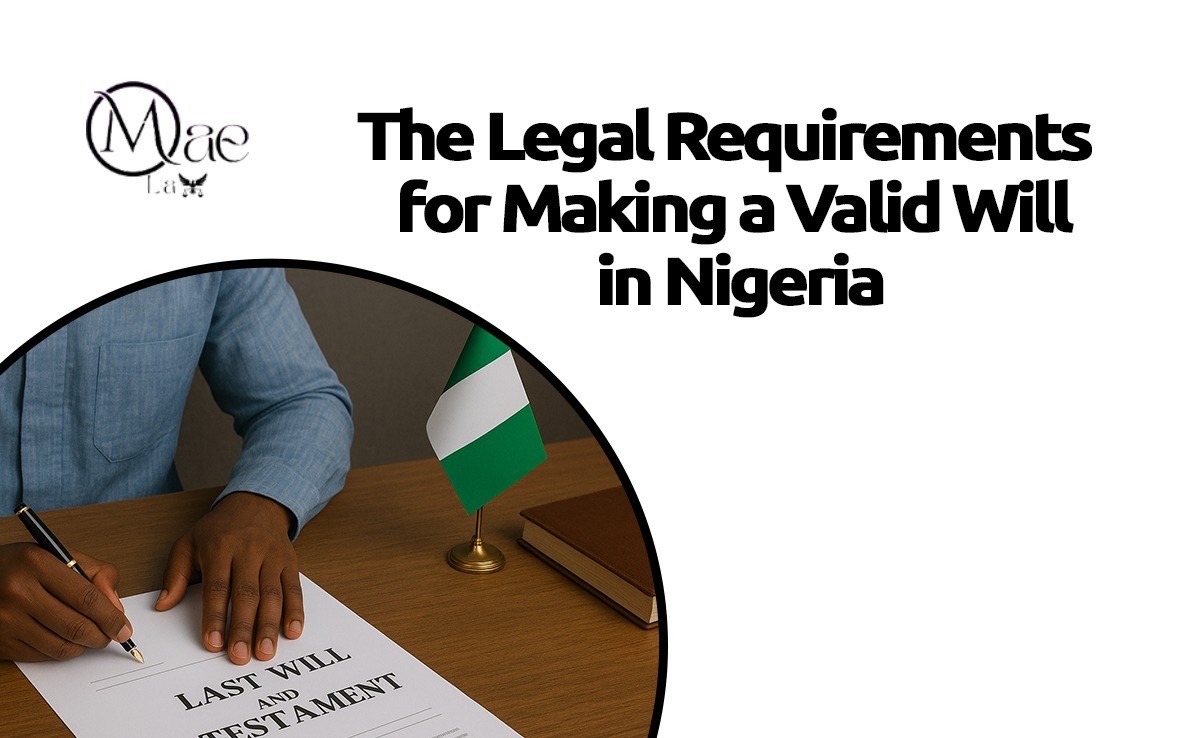
Making a will is one of the most important steps you can take to make sure your wishes are honoured after you die. In Nigeria, where statutory law, customary practices and religion interact, getting a will right is especially important if you want to avoid family disputes, lengthy probate battles and unintended distributions of your estate.
This blog explains, in clear terms, the legal requirements for making a valid will in Nigeria, highlights special situations you should know about, and gives practical tips to reduce the chances of your will being challenged.
What is a will?
A will, also referred to as a “last will and testament,” is a legal instrument through which an individual (the testator) specifies the distribution of their assets and rights following their death. It may designate executors responsible for fulfilling the testator’s intentions, establish trusts, appoint guardians for minor children, or provide for charitable donations. A will becomes effective solely upon the death of the testator and can typically be revoked by the testator while they are still alive. Courts will only enforce a will that adheres to the required legal formalities.
Core legal requirements for a valid will
While small variations exist between jurisdictions and specific statutes, the following requirements are the backbone of what Nigerian courts expect for a valid will.
1. The will must be in writing
Under Nigerian law, a will must be in writing. Oral (nuncupative) wills are generally not recognised except in narrowly defined circumstances (e.g., certain rules historically applied to sailors or soldiers); the safe course is to produce a written will.
2. Testator’s age (the minimum legal age)
Most Wills Laws in Nigeria set the minimum age for making a will at 18 years. (Historically, English law used 21, and certain old provisions still reference that age, so you may see older references. Modern Wills Laws in Nigeria commonly use 18.) There are a few limited exceptions (for example, mariners or members of the armed forces on active service may make valid wills even if under the age threshold, under specific statutory provisions).
3. Testamentary capacity (sound mind)
The testator must have the necessary mental capacity when making the will. This means they must:
- Understand that they are making a will and appreciate its effect;
- Know the nature and value of their property and assets; and
- Comprehend the claims to which they ought to give effect (i.e., who their natural dependants are).
If the testator lacks this “sound disposing mind,” the will can be set aside as invalid. Capacity is assessed at the time the will is executed.
4. Voluntariness, no undue influence, fraud or duress
The will must be made freely and voluntarily. If a will is proved to be the product of coercion, undue influence, fraud (e.g., someone forging a signature), or a mistake regarding the document’s nature, a court may declare it invalid. Courts pay close attention to where beneficiaries or caretakers are involved in drafting or witnessing the document.
5. Signature and witnessing formalities
Execution formalities are crucial, failure here is one of the commonest grounds for invalidating a will.
- Signature by the testator: The will must be signed by the testator. If the testator cannot sign personally, another person may sign on their behalf but must do so in the testator’s presence and at their direction.
- Witnesses: At least two witnesses must witness the testator’s signature (or the testator’s acknowledgement of a previous signature) and then sign the will themselves in the presence of the testator. The witnesses should be mentally competent adults. It’s widely recommended that beneficiaries should not act as witnesses (some statutes provide that gifts to an attesting witness may be void or contested).
Section 9 of the Wills Act (as applied in Nigeria and in many states’ Wills Laws) is the statutory reference often cited for these formalities. Strict compliance is usually required; courts are reluctant to validate wills executed without the required formalities unless exceptional statutory allowances apply.
6. Date and clear testamentary intention
A valid will should be dated (this helps determine priority where multiple wills exist) and clearly express an intention to dispose of property upon death. Ambiguous, unsigned or undated documents can produce disputes and litigation.
An Overview of the Legal Framework in Nigeria
Nigerian succession law is derived from various sources:
• Statutory Wills legislation: The formal regulations regarding the execution of a will come from Wills Acts or Wills Laws that have been adopted or modified in different states (often based on English law), along with the historical provisions of the English Wills Act as they apply in Nigeria. Certain states, like Lagos, have their own Wills Laws that either restate or alter these regulations.
• Court decisions (case law): Nigerian courts have established principles concerning capacity, undue influence, and the interpretation of unclear wills. Legal
• Customary and religious rules: In the absence of a valid written will, intestacy rules based on customary law or Islamic law may be applicable in certain regions of the country. This highlights the importance of having a valid written will to prevent default distributions under customary law.
Given these overlapping sources, it is wise and common practice to seek professional legal advice when creating a will that involves substantial assets, international elements, or potential family disputes.
Special situations and exceptions
Soldiers, mariners and airline crew (and similar exceptions)
Some Wills Laws expressly allow seamen, mariners, aircrew, and members of the armed forces on active service to make valid wills under relaxed formalities or regardless of age in certain circumstances. These rules reflect the mobility and risk of those professions but are narrowly framed; don’t rely on them unless the statute applies to your situation.
Holographic wills and electronic wills
Holographic wills (entirely handwritten and signed by the testator without witnesses) are not generally accepted in Nigeria unless a particular statute or court decision allows them.
Practical steps to make a will in Nigeria (a checklist)
- Decide what property you want to deal with and who the beneficiaries will be.
- Choose an executor (and an alternate). The executor will apply for probate when you die and administer your estate.
- Draft the will (preferably with a lawyer) so it is clear, unambiguous and legally compliant. Reach out to us for your will drafting services.
- Ensure the testator signs the will in the presence of two independent witnesses, and those witnesses sign in the testator’s presence. Record the date.
- Keep the original will in a safe place; it should be deposited in the probate registry of the state.
- Update the will when circumstances change (marriage, divorce, children, new property).
Conclusion
A well-drafted will is one of the best gifts you can leave your loved ones: it reduces friction, preserves assets, and ensures your wishes are respected. In Nigeria, where multiple laws and traditions intersect, the formalities and issues we’ve discussed matter a great deal. Follow the legal requirements (writing, age, capacity, signature and at least two witnesses), get professional advice for complex situations, and keep your will up to date. For more information, reach out today.
This Post Has 0 Comments