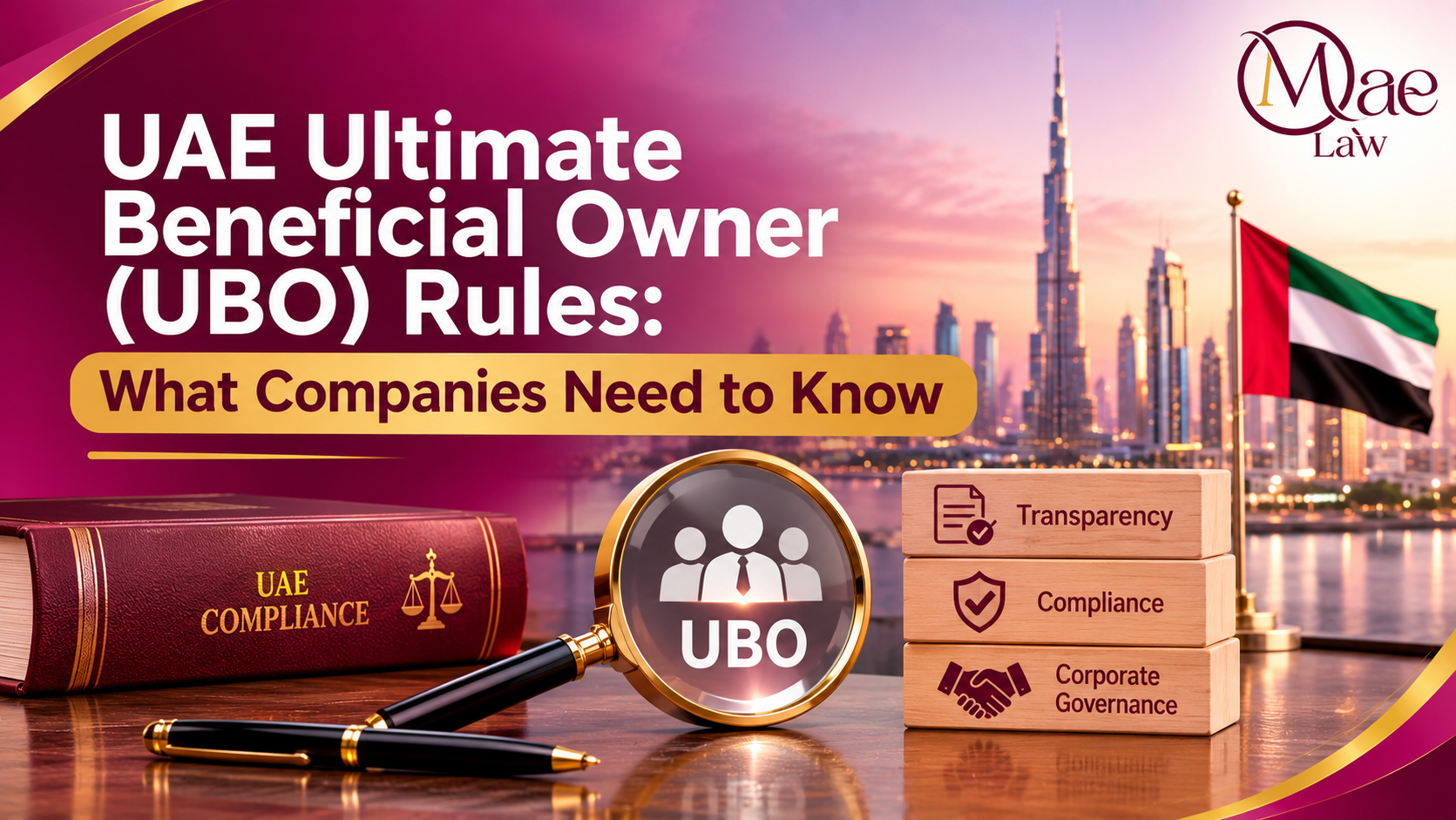
Who ultimately owns or controls your UAE company? The answer may be unclear when shares are held through other companies or someone controls decisions without being a registered shareholder.
The UAE Ultimate Beneficial Owner (UBO) rules require many UAE-registered entities to identify the individuals behind ownership or control, maintain accurate registers and provide information to the registrar. This is an ongoing compliance duty.
The federal framework is Cabinet Decision No. 109 of 2023, replacing the 2020 regime. Penalties are set out in Cabinet Resolution No. 132 of 2023
What Is an Ultimate Beneficial Owner?
An Ultimate Beneficial Owner (UBO) is the natural person who ultimately owns or controls a company, directly or through other entities or arrangements. A corporate shareholder is not itself the UBO; the company must trace the ownership chain to the individual behind it. Control may also come from voting rights or the power to appoint or remove most directors.
Who Qualifies as a UBO Under UAE Law?
Under Cabinet Decision No. 109 of 2023, an individual generally qualifies if they directly or indirectly:
- Own 25% or more of the company’s capital;
- Hold 25% or more of its voting rights; or
- Exercise control through other means, such as the right to appoint or dismiss a majority of directors.
More than one person may qualify, so trace every ownership layer.
What If Nobody Meets the 25% Threshold?
The company must still check whether someone exercises control in another way. If reasonable steps do not identify an individual through the ownership or control tests, the rules provide a fallback: the natural person holding the relevant senior management position may be treated as the beneficial owner. This is a last resort, not a shortcut.
Which UAE Companies Must Comply?
Cabinet Decision No. 109 generally applies to legal persons licensed or registered in the UAE, including commercial free zone companies. Exemptions include certain government-owned companies and their wholly owned subsidiaries, Financial Free Zones and Governmental Partners defined in the decision.
The DIFC and ADGM have separate UBO frameworks, so companies there should follow their own authority’s rules. ADGM published further beneficial ownership amendments in 2026.
A limited exception applies to certain entities owned by listed companies with qualifying disclosure requirements and their majority-owned subsidiaries. It concerns the duty to take reasonable measures to obtain and maintain UBO information, not every requirement.
What Records Must a Company Keep?
In-scope businesses must maintain:
- Beneficial Owner’s Record: Each UBO’s details and the basis for their status.
- Register of Partners or Shareholders: Shareholdings, voting rights and acquisition dates.
- Nominee board member information: Details of directors acting on another person’s instructions.
The initial records and filing are subject to a 60-day period, measured from the decision taking effect for existing entities or from licensing and registration for new entities. The transition period for existing companies has passed, so records should remain complete and current.
What Information Must Be Disclosed?
The Beneficial Owner’s Record includes each UBO’s name, nationality, birth details, residential or notification address, identity-document details and the date and basis on which they became or ceased to be a UBO.
The Partners or Shareholders Register records share details, voting rights, acquisition dates and prescribed identity information. Companies must submit the registers to the registrar and name a UAE-resident individual as a contact for disclosure requests. Additional information requested by the registrar generally must be provided within 14 days.
The registers are not public records, but may be disclosed where law, competent authorities or international information-sharing arrangements permit.
When Must UBO Information Be Updated?
Update the Beneficial Owner’s Record within 15 days of becoming aware of a change. The Partners or Shareholders Register also has a 15-day update requirement, and relevant changes must be submitted to the registrar within the applicable period.
A share transfer or new voting agreement may change who qualifies.
For help with wider UAE corporate services, review your records and filing duties together.
What Are the Penalties for UBO Non-Compliance?
Cabinet Resolution No. 132 of 2023 sets penalties for different breaches. Many first violations begin with a written warning and time to correct the issue.
Examples include:
- Failure to establish and maintain the UBO register: AED 50,000 for a second violation and AED 100,000 for a third.
- Failure to update the UBO register: AED 15,000 for a second violation and AED 30,000 for a third.
For a third-time violation, the registrar may suspend the commercial licence and close the premises until the fine is paid and the breach corrected. A grievance may be filed within 30 days of notification.
A Practical UBO Compliance Checklist
- Confirm the applicable UBO regime and registrar.
- Trace ownership and control to the natural persons involved.
- Check the 25% ownership and voting-rights tests.
- Maintain both registers and nominee board member details.
- Name a UAE-resident contact person.
- Update within 15 days and answer registrar requests within 14 days.
Conclusion
UBO compliance is an ongoing part of good corporate governance. Know who ultimately owns or controls your company, keep records current and act promptly when ownership changes. This also supports wider AML compliance practices.
Mae Adeola Law provides corporate compliance guidance. If you need help reviewing your ownership structure or disclosure duties, Contact now.
This Post Has 0 Comments